
The White Tiger makes a stinging commentary on New India's half-baked vision, but Ramin Bahrani isn't telling a Slumdog fairy tale here, observes Sukanya Verma.

After helping the government in policymaking since October 2014, Chief Economic Adviser Arvind Subramanian is returning to academics and will be teaching at Harvard Kennedy School on a visiting position. In an interview to Dilasha Seth and Somesh Jha, he says the ease of doing business agenda needs to move forward and India must try to integrate with the global value chains. Edited excerpts.

The UK has responded to PM Modi's call to 'Make in India' by launching great collaborations in January 2015.
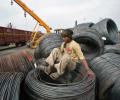
On an average most commodities are up between 20-30 per cent compared to a year ago levels.

We are witnessing a new phase where business leaders are realising globalisation has to take into account national identities and cultures, says Claude Smadja.

A combination of externalities such as global trade wars and slowing growth, continuing glitches in accessing offsets under the GST regime, which has created a liquidity crunch for smaller exporters, and the growing competitiveness of smaller countries are causing the slowdown.
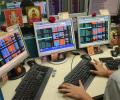
The bond market expects at least 25 basis points cut in the June 6 policy.

First, there has been a significant softening in commodity prices - most notably oil.

Currently, the select committee is considering the Bill.
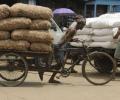
The IMF's predictions for India's near-term growth may seem rosy, but the usual caveats apply - that is, we are apt to under-perform.

Echoing the position articulated by Prime Minister Manmohan Singh, China and Russia on Thursday warned that imminent withdrawal of fiscal stimulus by the US could have an adverse impact on the global economy and cautioned the Obama administration against it.
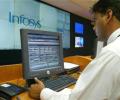
The Street is especially looking forward to the management commentary to get a sense of its new direction

The broader NSE Nifty closed 1.25 points, or 0.01 per cent down at 10,564.05.
.jpg)
CII hopes that the RBI would not wait for the next quarterly review but intervene sooner if the economic condition warrants a mid-course correction.

Ahead of the G-20 summit in Osaka this week, Xi has reasserted China's role as a global player, points out Dr Rajaram Panda.

The rupee has been under immense pressure due to a host of reasons including soaring crude oil prices, sustained foreign fund outflows and widening current account deficit.

The year 2015 may well turn out to be a watershed in global macroeconomic adjustment.

Undergraduate courses indicatively cost S$23,000 to S$38,000, while postgraduate courses approximately cost S$15,000 to S$40,000.
Despite the 3 per cent gain in September 2019, the FPI sell-off during the quarter has seen the benchmark indices - the S&P BSE Sensex and the Nifty 50 register negative returns in Q3CY19.

Stock markets in structural bull run but there can be bouts of volatility says Ravi Gopalakrishnan, head, equities, Canara Robeco Mutual Fund

President Xi Jinping's visit may put relations between India and China on a new trajectory

The need of the hour is to strike a balance between the capability of the conventional and the prospect of the renewable to give a realistic shape to the Prime Minister's vision, says Rajiv Mishra.
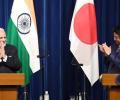
'Relations between India and Japan are robust and devoid of either shadow of history or any irritant.' 'In fact, there is plenty of warmth and goodwill earned over history. There are no negatives but only opportunities,' notes Dr Rajaram Panda.

Asian stocks sagged on Monday, with risk sentiment dampened as Shanghai shares wobbled after the Chinese markets resumed trading following a four-day long weekend.

India will surpass China as the world's fastest growing economy in the next 2-3 years, says RIL chairman Mukesh Ambani.

Euro-zone growth could improve because of (a) reduced pace of fiscal tightening and (b) stronger exports, but weak domestic demand and a fragile banking system could increase deflation risks that could force the European Central Bank to turn further accommodative.
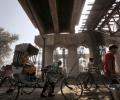
'The government must keep bad news out of the newspapers. If you have news about a fight everyday, it is not a climate where investment takes place.'
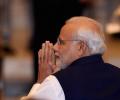
Modi has taken a slew of measures to attract investment, but he has yet to initiate steps that could help repair corporate balance sheets.

Revising India's GDP upwards by 0.3 per cent to 6.3 per cent in 2015, Asian Development Bank (ADB) has said the economy shows a new promise of turnaround after the election brought a stable government in May.
The report cautioned that low capacity utilisation and stressed balance sheets of banks and businesses will prevent a strong investment revival in the short term.

Given the various risks to growth, one could argue for rate cuts to be deeper than the 5 per cent terminal repo rate that we are projecting at this stage, says Kaushik Das.

India will surpass China to become the most populous nation in the world by 2022, six years sooner than previously forecast, and the country is projected to retain the top spot till 2100, the UN has said.
India has not been able to compete with countries such as Bangladesh and Vietnam.

Broader markets are outperforming the benchmark indices- BSE Midcap and Smallcap indices are up 0.8%-1%.
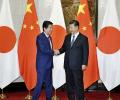
'Both Japan and China face a common challenge: How to deal with Trump.' 'The trade war with the US seems to have facilitated/hastened Abe's China visit, the first by a Japanese prime minister since 2011,' points out Dr Rajaram Panda.

Prime Minister Narendra Modi on Friday arrived in Australia on the second leg of his three-nation tour during which he will attend the annual G20 summit and hold bilateral talks with his Australian counterpart Tony Abbott.

Investor sentiment got a boost following remarks from the Russian President Putin that allayed fears of an imminent military conflict in Ukraine

'A pandemic like this will leave behind a trail of political, economic, social and psychological scars.' Coronavirus is going to impact every being on earth even if they do not contract it.' 'Everyone will pay a price,' cautions Ramesh Menon.
India is projected to see moderate average annual growth of 5.9 per cent during the 2014-18 period amid the country witnessing macroeconomic weaknesses, according to Paris-based think tank OECD.
CREDAI Chairman Lalit Jain said a long term status quo on interest rates would not help prospective home buyers.
